
Most creators who search for an AI short film tutorial already have an idea. The problem is that the idea usually stays vague. “A woman gets bad news in a coffee shop” or “Two friends argue on a rooftop at night” feels promising until you open the tool and realize you still don’t know what the scene is actually about. That is the exact gap this method closes.
I’m Claire Morgan. After years of writing short-form narrative and producing vertical video, I learned that the difference between a folder of pretty clips and a finished 60-second AI drama is almost always the quality of the initial brief. The process below is the one I use on every project before I generate a single frame. It turns a one-sentence idea into a production-ready plan that keeps characters consistent, shots purposeful, and the final edit coherent.
Why One Sentence Is Enough — If You Expand It Correctly
A strong one-sentence idea already contains the seed of conflict and change. The mistake is treating that sentence as a prompt. It is not. It is raw material that still needs structure.
A usable 60-second AI short drama needs five clear answers:
Who wants something?
What stands in the way?
What single change happens by the end?
What does the audience need to understand or feel?
Which three to five shots will deliver that information?
When those answers exist on paper, every later decision — character references, camera language, dialogue, voice direction, edit order — has a standard to measure against. Without them, generations become random and continuity problems multiply.
I keep a simple template on my desk. Every new idea goes through it before any software opens. The whole process takes fifteen to twenty-five minutes and saves hours of wasted generations later.
Step 1: Write the One-Sentence Idea Cleanly
Start by stripping the idea down to its core. Remove atmosphere, style adjectives, and tool language. Keep only character, action, and implied change.
Weak version:
“A cinematic shot of a sad woman in a rainy coffee shop receiving a text that changes everything, highly detailed, emotional lighting.”
Clean version:
“A woman in a coffee shop receives a text that forces her to choose between staying and leaving.”
The second version is usable. It names the character, the location, the trigger, and the decision. Everything else can be decided later.
Write three or four variations if needed. Choose the one that contains the clearest potential turn. That becomes your starting sentence.
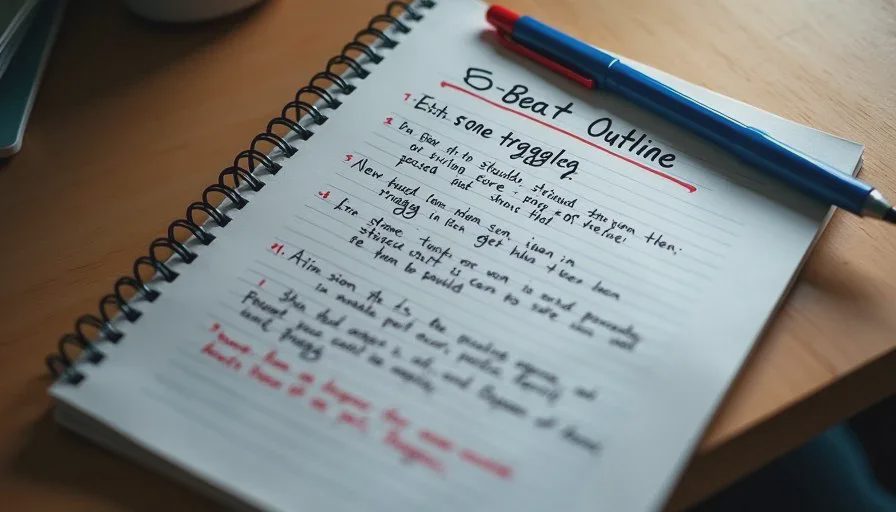
Step 2: Expand into a Five-Beat Scene Outline
A 60-second piece does not need a full three-act structure. It needs five beats that create a complete mini-arc.
Here is the outline I use:
Beat 1 – Establish: Show the character in their current state and location.
Beat 2 – Trigger: Introduce the event or information that creates pressure.
Beat 3 – Struggle: Show the character reacting or trying to handle the pressure.
Beat 4 – Turn: Deliver the moment the situation or the character’s position changes.
Beat 5 – New State: End on the consequence or the decision that now exists.
Using the coffee-shop example:
Establish: Woman sits alone, calm, waiting.
Trigger: Phone lights up with the message.
Struggle: She reads it, looks around, starts to reply then stops.
Turn: She puts the phone face down and stands up.
New State: She walks out, leaving the unfinished coffee.
These five beats give the scene a beginning, middle, and end. They also tell you exactly what each shot needs to accomplish.
Step 3: Define Character Goal and Obstacle
Even in sixty seconds, the character must want something specific. Vague emotion is not enough.
Ask:
What does the character want in this moment?
What is actively preventing it?
Who or what has the higher status at the start, and does that status shift?
In the example, the woman wants to stay in the safe, familiar moment. The text forces a decision she has been avoiding. The obstacle is the information itself and the life change it represents.
Write these two lines clearly:
Goal: Stay in the present moment and delay the decision.
Obstacle: The message makes delay impossible.
This pair becomes the engine of the scene. Every generation is checked against it. If a shot looks beautiful but does not show the goal or the obstacle, it is set aside.
Step 4: Build a Minimal Shot List
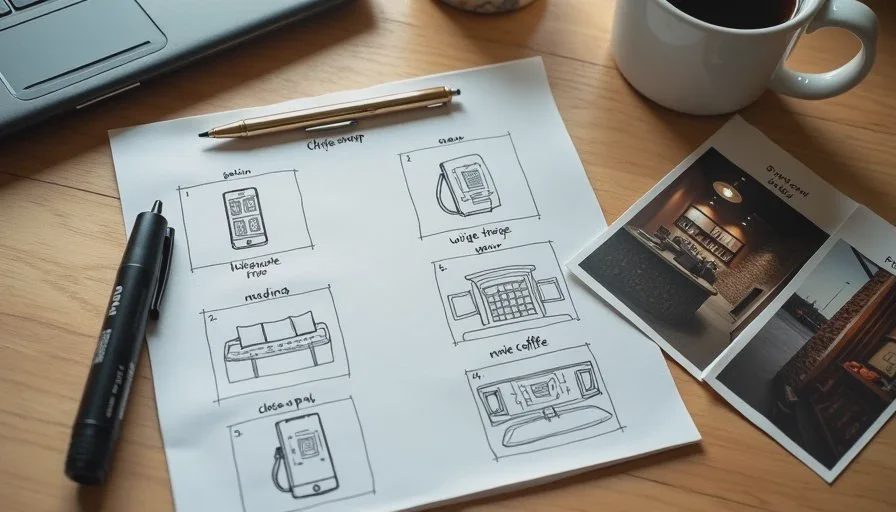
Now translate the five beats into camera language. Keep the list short. Three to five shots are usually enough for sixty seconds.
A reliable beginner pattern:
Wide or medium-wide establishing shot (location + character state)
Medium shot on the trigger moment
Close-up on the emotional or decision peak
Reaction or insert that confirms the turn
Final medium or wide that shows the new state
For the coffee-shop scene the list might look like:
Wide: Woman at table, café interior visible, calm posture
Medium: Phone lights up, she picks it up
Close-up: Her eyes while reading, small shift in expression
Insert: Phone placed face-down on the table
Medium-wide: She stands and walks toward the door
This list is the production map. It tells you what reference images you need, what continuity must be locked (face, clothing, table items, lighting direction), and which shots can tolerate more variation.
Step 5: Write the Production Brief
Combine everything into one short document you can keep open while generating. Mine usually contains:
One-sentence idea
Five-beat outline
Character goal and obstacle
Shot list with intention for each shot
Notes on dialogue (if any) or silence
Continuity must-haves (face reference, wardrobe, key props)
Intended final length and platform (vertical, 9:16)
This brief is not a script. It is a directing document. When a generation comes back inconsistent, you can immediately see whether the problem is technical or whether the shot no longer serves its intended beat. That diagnosis is faster and more accurate than trying to fix random beautiful failures.
Common Pitfalls and How to Avoid Them
I still make these mistakes when I rush:
Adding style language too early. “Cinematic,” “moody,” and “highly detailed” belong in the generation stage, not the idea stage.
Writing beats that describe emotion instead of action. “She feels devastated” is harder to shoot than “She puts the phone down and does not reply.”
Creating a shot list with too many close-ups. Without a clear establishing shot, the audience never knows where they are.
Skipping the goal-and-obstacle step because the idea “already feels emotional.” Emotion without clear want and obstacle usually plays flat.
When any of these appear, I return to the one-sentence idea and rebuild the five beats. It is faster than trying to rescue a pile of disconnected generations.
What This Method Does Not Promise
This process will not guarantee a viral video or effortless cinematic quality. It will not eliminate continuity problems or the need for multiple generations. What it does is give every generation a job and every revision a clear standard. The finished 60-second piece is more likely to feel directed because it was directed from the first sentence.
A good AI short drama still needs a human director. The tools remain powerful. The person who decides what the scene is about, what the character wants, and how the sixty seconds should land is still doing the essential work.
Take any idea you currently have. Run it through the five steps. Write the brief. Then open the tool. The difference in the final result is usually obvious within the first few generations.



Travellers Write
No letters yet — be the first traveller to write.