
Some of the most frustrating AI generations look expensive and still feel empty. The lighting is polished, the movement is smooth, the frame is balanced, and yet the shot communicates almost nothing about what the character wants or feels. Viewers often describe these clips as “cinematic but cold.” The problem is rarely a lack of visual quality. It is a lack of emotional clarity.
I’m Claire Morgan. I have generated plenty of beautiful shots that failed in the edit because they did not tell the audience what mattered in the moment. Over time I developed a short diagnostic process and a set of practical fixes. This post walks through both so you can rescue footage that looks good but does not land.
Why “Cinematic” and “Clear” Are Not the Same Thing
Cinematic language—shallow depth of field, controlled lighting, deliberate camera movement—creates a feeling of production value. Emotional clarity comes from different sources: a readable intention, a visible change in the character, and a shot that serves a specific story beat.
When those elements are missing, the polish can actually make the emptiness more noticeable. The audience senses that something important should be happening and cannot find it.
Most emotionally flat AI shots share one or more of these traits:
The character’s face and body show no clear intention
The shot could be cut from the scene without changing the story
The camera move exists for visual interest rather than emphasis
The lighting and composition draw attention to themselves instead of the behavior
The fix begins with diagnosis, not with more generation.
A Simple Diagnostic: What Is the Audience Supposed to Understand?
Before regenerating anything, I ask one question of the shot:
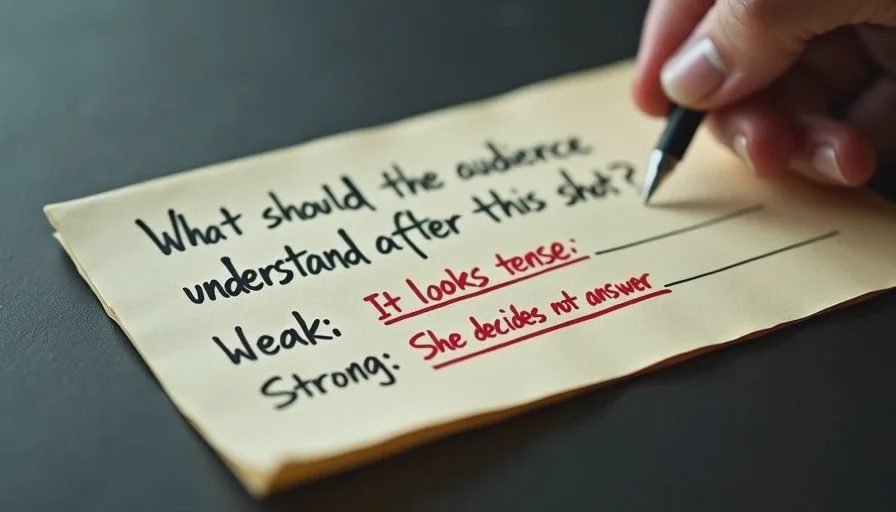
“What should the audience understand or feel after seeing this?”
If I cannot answer in one clear sentence, the shot does not yet have a job. Common weak answers include “it looks tense” or “it feels cinematic.” Stronger answers are specific: “She decides not to answer the phone” or “He realizes the other person is lying.”
Write the answer down. That sentence becomes the standard for every adjustment that follows. If a change does not serve that sentence, it is decoration.
Fix 1: Clarify the Character’s Intention in the Frame
Emotional flatness often starts with performance direction that is too vague. Prompts that say “emotional,” “sad,” or “intense” leave the model to invent a generic expression. The result frequently looks like a stock reaction rather than a specific intention.
Replace abstract emotion words with observable behavior:
Instead of “sad” → “eyes lowered, mouth closed and still, shoulders slightly dropped”
Instead of “angry” → “jaw set, direct eye contact, minimal blinking”
Instead of “thoughtful” → “gaze slightly off-camera, one hand resting near the mouth, slow blink”
These physical directions give the model something concrete to generate and give you something concrete to evaluate. When the new generation arrives, check whether the face and body support the story sentence you wrote earlier.
Fix 2: Make Sure the Shot Serves a Beat
A shot that looks good but sits outside the five-beat structure is a common source of emotional emptiness. It may be beautiful, yet it does not advance Establish, Trigger, Struggle, Turn, or New State.
Return to the shot list. Ask whether the current frame is the best possible vehicle for its assigned beat. If the beat is the Turn, the shot should make the decision or realization unmistakable. If the beat is Struggle, the shot should show effort or resistance.
When a polished shot does not serve its beat, I either re-direct it or replace it. Keeping it because it looks expensive usually weakens the scene.

Fix 3: Simplify the Camera and Let Behavior Lead
Complex camera moves can mask weak performance. A slow push-in, a lateral track, or a dramatic reveal feels purposeful even when the character is doing very little. The movement creates the illusion of meaning.
In emotionally unclear shots I often reduce or remove camera motion first. A static or minimally moving frame forces the performance and the framing to carry the weight. If the shot still feels empty after the move is simplified, the problem is not the camera—it is the behavior or the story placement.
When motion is necessary, I tie it to a specific change: the push-in begins only when the decision registers on the face; the camera holds until the character completes the action. Motion then supports clarity instead of substituting for it.
Fix 4: Use Contrast and Change Inside the Shot
Emotion is easier to read when something changes. A face that remains in the same expression for the entire duration of a shot often feels static even if the expression itself is strong.
Look for a small but visible shift: a change in eye direction, a breath, a decision that alters posture, a hand that stops moving. These micro-changes give the audience a moment to register. In generation terms this means prompting for a short performance arc rather than a single held state.
In the edit, I also protect the moments of change. Cutting away too quickly from the exact frame where the intention becomes clear is a frequent way to lose emotional impact.
Fix 5: Check the Edit Context, Not Just the Isolated Clip
A shot that feels flat in isolation sometimes works once it is surrounded by the right neighbors. The opposite is also true: a shot that seems expressive alone can lose meaning when the surrounding clips do not set it up or pay it off.
I always diagnose emotional clarity inside a temporary assembly, not as a single file. Play the sequence. When the energy drops, stop and examine the shot that sits at the low point. The problem may be the shot itself, or it may be the absence of a clear Trigger before it or a clear New State after it.
This context check prevents unnecessary regeneration of shots that are actually fine and focuses effort on the places where the emotional thread truly breaks.
A Practical Rescue Sequence
When I inherit a scene full of polished but unclear shots, I follow this order:
Write the intended understanding for each shot in one sentence.
Eliminate or re-direct any shot that has no clear sentence.
Replace abstract performance language with physical direction and regenerate key frames.
Simplify camera movement so behavior carries more weight.
Rebuild a temporary assembly and test whether the emotional line now reads.
Only then refine lighting, texture, or secondary motion.
This sequence keeps the work focused on communication rather than on making already-pretty frames even prettier.
What Success Looks Like
A shot has emotional clarity when a viewer who does not know the full story can still sense what matters in that moment. They may not know every plot detail, but they can feel the pressure, the decision, or the shift. The cinematic qualities then support the feeling instead of substituting for it.
A good AI short drama still needs a human director. Visual polish is relatively easy to obtain. Emotional clarity requires decisions about intention, behavior, and structure. When those decisions are present, the same tools that once produced empty beauty start producing scenes that hold attention for the right reasons.
Take one shot from your current project that looks strong but feels hollow. Write the one-sentence job it is supposed to do. Then adjust the performance direction, the camera, or its place in the sequence until that sentence becomes obvious. The difference is usually visible within a few focused iterations.



Travellers Write
No letters yet — be the first traveller to write.