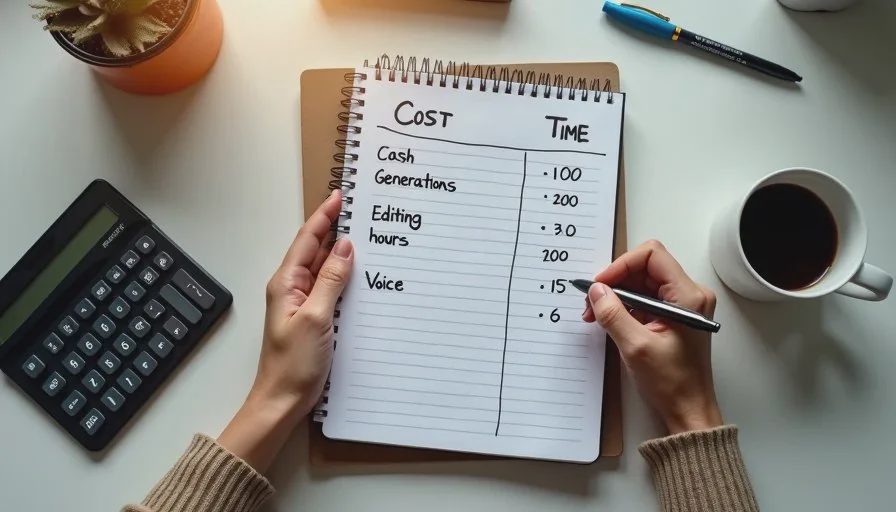
Ask ten AI filmmakers what a one-minute short drama costs and you will hear numbers that differ by an order of magnitude. Some quote only the subscription fees. Others count every failed generation and every hour of editing. Most public estimates leave out the time cost entirely. The result is a distorted picture that makes the work look either impossibly cheap or mysteriously expensive.
I’m Claire Morgan. I track both money and time on my own projects because the real cost of a finished piece is the combination of the two. This post breaks down what a typical one-minute AI short drama actually requires when you include tools, generations, revisions, sound, editing, and the hours that never appear on a receipt.
The Two Currencies: Money and Time
AI production spends two things: cash and attention. Cash is relatively easy to measure. Attention is the larger and less visible cost for most independent creators.
A project that costs thirty dollars in subscriptions but consumes fourteen focused hours is not a thirty-dollar film. It is a fourteen-hour film that also happened to cost thirty dollars. Treating time as free is the most common way creators underestimate the true expense of their work.
I record both. The numbers below reflect a realistic independent workflow for a single 60-second narrative scene with two characters, locked continuity, dialogue, and a vertical master.
Typical Cash Costs
Cash expenses usually fall into a few categories:
Image generation access (subscription or credits)
Video / image-to-video access
Voice generation
Editing software (often already owned)
Stock sound or music (if used)
Occasional storage or transfer costs
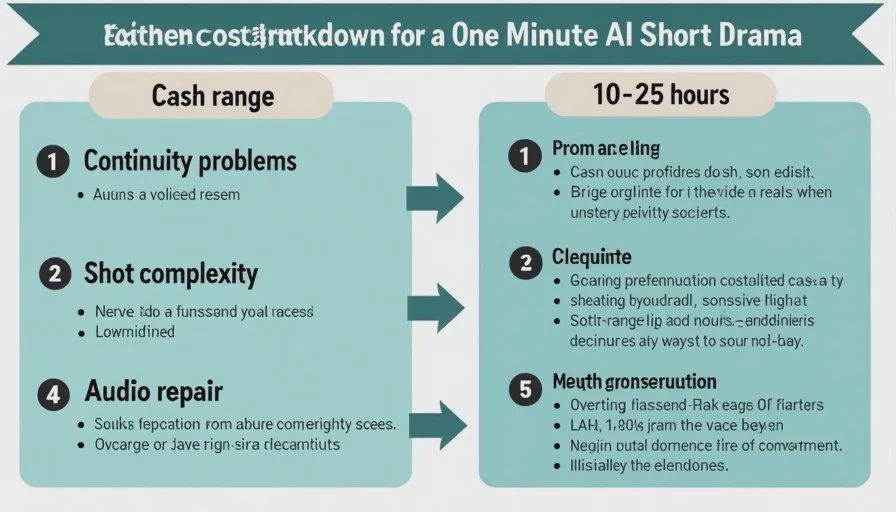
For a single one-minute piece made by someone who already pays for the main tools, the incremental cash cost is often modest—commonly in the range of a few dollars to a few tens of dollars depending on how many generations are required and whether any premium voice or motion features are used.
The range widens dramatically for creators who do not yet have subscriptions and must pay per generation or per minute of output. It also widens when a project requires many more iterations than expected because of continuity or performance problems.
Cash is real, but for most people reading this it is not the dominant constraint.
The Larger Cost: Time
Time is where the real variation appears. A smooth project and a difficult project can differ by several times in hours spent even when the final length is identical.
A realistic independent timeline for a finished one-minute drama often includes:
Story brief, character bibles, and shot list: 1–2 hours
Reference image generation and selection: 1–3 hours
Scene stills and motion generation (including rejects): 3–8 hours
Voice generation, alignment, and dialogue repair: 1–3 hours
Editing, sound, captions, and vertical formatting: 2–5 hours
Reviews, small fixes, and export: 1–2 hours
On a clean project the total can land around 10–15 focused hours. On a project that fights continuity or performance, 20–25 hours is not unusual. First-time attempts at a new workflow frequently run longer.
These hours are the main cost for most solo creators. They are also the cost that improves with practice. The second and third pieces in the same workflow almost always move faster than the first.
Hidden and Easy-to-Miss Expenses
Several costs rarely appear in public estimates:
Failed generations that still consume credits or time
The learning time spent understanding a new tool’s current behavior
Re-work caused by changing a character lock mid-project
Platform-specific formatting and caption adjustments
The mental load of keeping continuity notes, version names, and review decisions organized
I also count the cost of decisions deferred. Every time I postpone locking a face, a wardrobe, or a line of dialogue, I usually pay for it later in regenerations. The archive of failed versions is full of examples where an early decision would have been cheaper than the later cleanup.
What Drives Cost Up or Down
A few variables have outsized impact:
Continuity discipline
Projects that lock characters and lighting early cost less in both time and generations. Projects that discover drift in the edit cost more.
Shot count and complexity
A four-shot scene with restrained camera movement is dramatically cheaper than an eight-shot scene with complex motion and frequent character interaction.
Audio ambition
Simple, well-performed dialogue with clean lip sync is cheaper than multi-layered sound design or extensive voice repair.
Revision habits
Creators who generate dozens of variations before deciding what the shot must accomplish spend more than creators who clarify the job of the shot first.
Tool familiarity
The first project in a new toolset carries a learning tax. Later projects using the same stack are cheaper.
None of these variables is mysterious. All of them are under the creator’s control to a significant degree.
A Practical Way to Estimate Your Next Piece
Before starting, I write a short cost note:
Expected cash outlay for this project (incremental)
Target focused hours
Main risk factors that could push the numbers up (new character, complex dialogue, unfamiliar motion tool, etc.)
After the piece is finished I compare the note with reality. Over a few projects the estimates become more accurate and the overruns become more predictable.
This habit also makes it easier to decide whether a particular idea is worth the resources it will consume. Not every concept justifies a 20-hour investment. Some do. The cost note simply makes the trade-off visible.
Is It Getting Cheaper?
Tool prices and capabilities change. Some generation costs have fallen. Some quality improvements have reduced the number of retries needed for basic consistency. At the same time, rising expectations and more complex scenes can absorb those gains.
The part that remains stubbornly expensive is the human attention required to direct the work: deciding what the scene is about, locking the characters, evaluating whether a performance lands, and shaping the edit so the emotion is clear. That cost does not disappear when the tools get faster. In some ways it becomes more important.
A Realistic Summary
For an independent creator who already has access to the main tools, a finished one-minute AI short drama often costs a modest amount of incremental cash and a significant number of focused hours—commonly in the 10–20 hour range for a competent narrative scene, sometimes more on the first attempt at a new workflow.
The creators who consistently finish work are usually the ones who treat time as the primary budget and design their process to protect it. They lock early, generate with purpose, and accept that some ideas are too expensive for the current project.
A good AI short drama still needs a human director. Part of that job is knowing what the work actually costs and deciding, with open eyes, whether the result is worth the outlay. Track both the money and the hours on your next piece. The numbers will tell you more about your process than any single finished video can.



Travellers Write
No letters yet — be the first traveller to write.